

Welcome to our weekly column offering perspectives on lit mag publishing, with contributions from readers, writers and editors around the world.
Trying impossible things might seem like a useless exercise. If something’s impossible, why try? Try because you don’t actually know what’s possible and what isn’t yet. Humans are notoriously bad judges of their own limits. I’ve found an entirely new way to write through trying “impossible” things.
Good for me, but that sounds pretty lame compared to the Wright Brothers building the first airplane, or Edison (probably) inventing the lightbulb after hundreds of failed attempts. These were not minor technological advances. These were world changing. And they usually happened because one or two people tried to do something everyone else said was impossible. Things most people had never even thought of before.
Speaking of lightbulbs, did you know LED lights used to only come in red or green? That means they couldn’t be used for TVs or anything else that needed full color. Until Shuji Nakamura created one after years of working practically alone on it. Once made, it was worth billions, but most tech companies did not even think it was worth researching. To them it was “impossible.”
I had a much smaller dream: to write differently than everyone else. I decided, almost out of the blue one day, to write something that could be read forward and downward. This sounded impossible, but I decided to give it a go anyway. Eventually, after some failed attempts, I created poems like this:
Ocean
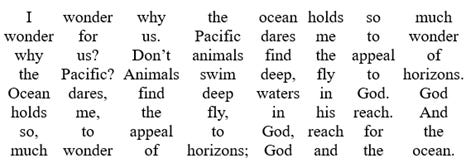
This poem was blocky and not very aesthetically pleasing, but I was still encouraged and a little surprised that it worked.
I experimented more and came up with this poem that can be read forward and backward, too.
Mirror
Mirror your view to shift the effect. Search the ending to get help to process the change. Answer that back to yourself for enough evidence to build and support your construct.
Construct your support and build to evidence enough for yourself to back that answer. Change the process to help get to ending the search. Effect the shift to view your mirror.
Again, I was surprised and encouraged. I’d never seen anyone else write like this. I decided to keep going. I wrote pieces where each word started with the next letter of the alphabet, where specific letters could be lined up to make other stanzas, poem codes where each nth word of a poem could be combined to make a new poem, and poetry using music notation letters that could be played on a piano. Some of these are forms that, as of now, AI writing tools can’t even replicate.
I wrote hundreds of symmetrical poems and kept discovering new forms all because of that first day that I tried something impossible and didn’t give up on it until it was finished. These new “impossible” forms opened up new publishing opportunities for me. Dozens of the poems have been published in various magazines, and I won an award and was interviewed for one of them.
Not only that, but my writing style overall has improved. Writing anything else seems easy in comparison to these “impossible” forms.
I heard recently that in some professions, even more important than consistency, is persistency. A refusal to accept ‘no’ as an answer. If you believe in your work, don’t give up on it, even if—especially if—people think it’s crazy or impossible. Sometimes, as the Wright Brothers found out, stubbornness pays off.
If you believe in your work, don’t give up on it, even if—especially if—people think it’s crazy or impossible.
It makes me think of writers like James Joyce who broke out of the boundaries of what was considered literature at the time. It must have been hard for him to continue writing in this new stream of consciousness style when no one else had written like that. No one else was supporting him. Well, maybe one person, actually. I heard a story in which James Joyce was talking to a friend one day. Joyce was very discouraged, feeling like a failure. He told his friend that he’d tried to write for a full day and only ended up with seven words.
“Cheer up,” his friend said. “That’s seven more words than you had yesterday.”
Joyce buried his head in his hands. “You don’t understand. I don’t even know what order they go in yet.”
James Joyce was tortured by the difficulty of his craft and the lack of support from European publishers, yet he kept going. He knew what he had was worth something, even if no one else understood it.
A small Irish press commissioned him to write stories for their journal, but after only three stories, they shut the door. His works were too different for them.
He kept writing, kept honing his craft, and finally, after his first novel, A Portrait of the Artist as a Young Man, was published in America in 1916, he started to receive some recognition. This paved the way for his full stream of consciousness novels to be published, too, even though they were “impossible” to read. They are now seen as classics.
Joyce did not seem to have a consistent writing schedule. What he did have was a brand-new style of writing and the persistency to see it through.
Sometimes, impossibility is actually the only path forward. Seven years ago, self-publishing a book seemed impossible for me, so I didn’t even give it much thought.
I went hiking alone near Bishop’s Peak in San Louis Obispo. To have a little more fun and test my navigation skills, I decided to go off trail and head straight for one of the peaks. Pretty soon I faced a sheer rock wall. Being my dumb adventurer self, I decided to climb it. It didn’t seem impossible then, just difficult. When I got to the top of the wall, I realized how stupid this was. I was at a dead end, surrounded by more rock. I was an amateur climber with bulky tennis shoes and no chalk, freeclimbing.
I had a decision to make. I could risk climbing back down, which was a lot harder than climbing up, or risk going the whole way, finishing what I started. I prayed, and then kept going.
At times, I really thought I was going to die. This was impossible. But I kept going. I had no choice by that time. When I reached the peak, I saw that I could get down on the other side much easier than the way I had come. I took a moment to celebrate and enjoy the incredible view. I was very happy to be alive.
Based on the fact that I’m still alive right now, climbing those cliffs was clearly possible. It would have been a piece of cake for real climbers. But it didn’t seem like it at the time. At the time, for me, it was impossible. Not anymore.
I am not advising free climbing. But there is a gift of confidence that comes when you believe something is impossible but do it anyway. A confidence that you can’t get anywhere else.
A year after the climbing experience, I self-published my first book, Stories and Symmetries. Suddenly, impossible things were much more doable.
There is a gift of confidence that comes when you believe something is impossible but do it anyway.
I used to only be able to write short stories. Writing anything longer seemed impossible. When I tried for a novel, it came out a novella every time. But after I published Stories and Symmetries, a collection of short stories and poetry, I sat down and wrote a 460-page novel. It was almost easy then, because I finally believed that I could.
The impossible things that I did built on each other. Each one was a step toward my next accomplishment. The Wright Brothers didn’t build a plane from scratch, they built a glider first. One impossible thing led to another.
One more quick story. I didn’t realize it at the time, but I think this mindset shift started back when I was in middle school. We had to do push-ups and sit ups to meet a national school standard. The standard was low—I don’t think anyone in my class failed. During the pushup section, one kid, Jhoven, didn’t stop when he hit the standard. So, neither did I. When we hit thirty, it was the most push-ups I had ever done. I thought that maybe I could do forty if I really tried. We hit forty, and I was surprised I hadn’t collapsed yet. When we hit fifty, I almost couldn’t believe it. I was running off of pure adrenaline, high off of the feeling of doing the impossible. My muscles ached, but I kept going.
I lost the contest, but I ended up doing sixty pushups. I had never heard of anyone doing that many push-ups before (I was only in middle school, remember). To me, I had just accomplished something impossible. I surprised myself, impressed myself. I believed I could do great things after that.
James Joyce didn’t quit writing, so neither will I. The Wright Brothers, Edison, and Nakamura didn’t give up on their visions, so neither should you.
Do impossible things. Surprise yourself. If not for benefiting the world, then at least for your own sake.
 | A guest post by
|
Thank you, Becky from Lit Mag News, for giving my work a try!
Thanks for reminding us that somewhere we’re all still in middle school and it’s cool to do what we then thought were impossible things! Sixty push-ups!
I loved that the focus is on ‘impossible for you’ (like a free climb for a non-free climber)! That makes it cool to do what is ordinary for others but ‘impossible’ for me! Thrilling adventures await! ❤️